Ella's mother's yellow cocktail dress
Cinder & EllaElla's mother's yellow cocktail dress is more than a garment: it is a cherished remnant of Ella's mother, chosen by Ella for a family dinner as a way to feel accompanied through grief. Its thin straps and knee-length hem leave Ella's scars visible, turning an act of remembrance into a confrontation with the Coleman family's discomfort and revealing how the hope of belonging can collide with the demand to conceal a wounded body.
Origins and Meaning
The dress had entered Ella's mother's wardrobe during a rare period when she could indulge in something special. Ella and her mother had not often dressed up, and although they had not been truly poor, they had to watch their spending and save for an exceptional purchase. When Ella was about thirteen, her mother dated a professional salsa dancer for several months. He loved taking her out dancing, and she went beyond her usual budget to buy the canary-yellow cocktail dress.
For Ella, the dress carries the memory of the woman who wore it as well as the circumstances of its purchase. She loved it more than any other item of clothing her mother had worn, remembering how beautiful her mother looked in it. Finding it among the boxes her father had packed brought relief. It no longer smelled like her mother, but that loss of scent did not diminish its meaning: the dress remained a physical possession through which Ella could recall her mother and feel close to her.
Wearing It to the Family Dinner
Before the dinner, Ella's father cleared everyone else from her room so she could change. She stared into a wardrobe she believed held nothing that could make her fit in with the Colemans. The yellow dress offered a different answer—not a way to resemble her new family, but a way to bring her mother with her. Ella pressed it to her face, breathed in, and whispered that she missed her mother and needed her to help face the evening.
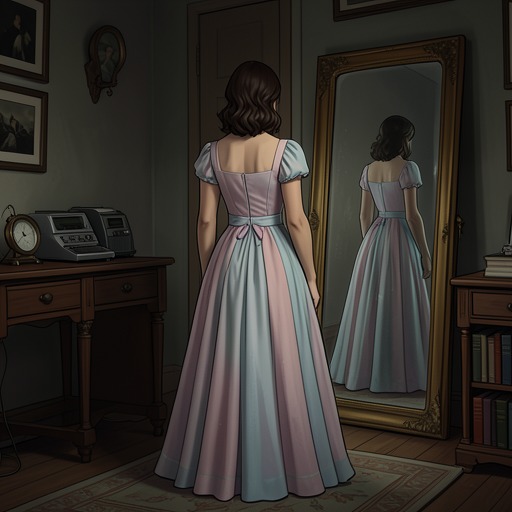
Ella pulled the dress over her head before she had fully considered the decision. It fit her perfectly, an ease she experienced as almost fated. The spaghetti straps and knee-length skirt left her scars exposed, and the thought of walking out that way caused her physical pain. Yet she knew people would stare at her regardless; wearing the dress meant taking a part of her mother into a dinner she expected to survive only with that sense of connection.
She added the pearl necklace her mother had always worn with it and arranged her hair in the same updo. Looking at herself for a long time, Ella could almost feel human again if she set her scars aside. In the mirror she recognized her mother looking back, seeing a resemblance between them except for their eyes. She took her cane and made her way to the entrance, where the waiting family fell silent at the sight of her.
The Family's Objection and Its Consequences
Anastasia immediately objected to the dress. Ella defended it by pointing out that the other women were wearing dresses too; when Jennifer tried to reassure her that she did not consider it indecent, Ella understood that indecency was not the issue. She concluded that the family did not want her wearing it because her scars would show, and that Jennifer was ashamed of her just as Anastasia and Juliette were.
Jennifer, crying, buried her face against Ella's father's shoulder. He embraced her and told Ella to stop trampling on the family's feelings, then ordered her to change. The response transformed the dress from a private source of comfort into the focus of a painful family rupture. Ella had not chosen it to make a point: she wanted her mother's presence at the dinner and wanted to be with her family without having to hide her scars. Her father's demand made her feel that even he could not be seen with her unless she covered them.
Ella answered by contrasting the family's reaction with the response she believed her mother would have given. Her mother, she said, would have held her and been proud of her courage rather than asking her to change; the scars would not have mattered because her mother loved her. Ella turned and slowly went back to her room, wishing she could run. She would not leave with the others unless her father physically carried her out. In that moment, the dress marked the difference between the unconditional acceptance Ella associated with her mother and the shame she felt from the household she was being asked to call family.
Recurrences in Grief and Memory
The dress belongs to a wider pattern in which ordinary family occasions bring Ella's grief back into the present. At a later dinner, the meal is unusually warm, and her father praises her enchiladas as perhaps even better than her mother's. Ella resists the comparison and begins to mention a Christmas possibility connected to her grandmother's sopaipillas, but a sharp pang of grief stops her. The episode does not return to the dress itself; it echoes the earlier dinner's tension between an emerging family ritual and the absence of the people Ella has lost.
That tension becomes especially acute around Ella's nineteenth birthday, which is also the first anniversary of her mother's death. The previous year, her mother had woken her with a crooked birthday song and planned a Vermont ski trip, an expensive dinner, and a dessert with a candle—plans Ella never got to experience. She also remembers how her mother had made birthdays special in years when her father forgot or ignored them. The yellow dress's earlier role, carrying her mother into a family gathering, anticipates how closely remembrance and celebration remain entangled for Ella.
Cinder also remembers the date because he had been chatting with Ella at the time of the accident. For him it marks the day he lost her; Ella had told him it was her birthday, and he promised to devise a way to distract her so the day could hold some enjoyment as well as thoughts of the accident. That promise brings a different kind of companionship from the one the dress provides: the garment offers a material link to her mother, while Cinder's remembrance acknowledges Ella's loss and birthday from outside her household.
The Dress's Lasting Significance
The garment's meaning rests in its double function. It restores a sense of closeness to Ella's mother through a familiar shape, necklace, and hairstyle, yet wearing it also places Ella's scars in the family's sight. The dress does not erase grief or make the household's rejection less painful; instead, it makes visible what is at stake when Ella asks to be present without disguising the body and history she carries.
Ella later describes a moment with Brian in which he made her feel beautiful, special, and loved, giving her a first genuine glimpse of hope after her accident. When cameras and intrusive questions ruined that private moment, she feared that her pain would become public entertainment. Her account underscores a recurring vulnerability: being seen can offer recognition and intimacy, but it can also expose Ella to judgment. In the family-dinner scene, the yellow dress makes that conflict concrete. It is at once a memorial object, a means of carrying love into the present, and the visible point at which Ella discovers how conditional her new family's welcome feels.